Symmetric Cryptography means this encryption algorithm use the same key for encryption and decryption. Although I am a web dog, encryption algorithm in some web question recently let me broken heart.
1. Some Symmetric Encryption Algorithm
DES、3DES、TDEA、Blowfish、RC2、RC4、RC5、IDEA、SKIPJACK
Here is another blog for S-DES which i wrote before.
2. Symmetric Cryptography in CTF-WEB
here are some crypto in ctf.which i know most is Padding Oracle or Cbc Flipped Ciphertext Bits.
for example CBC in NJCTF or shiyanba easy login question and so on . some i want introduce some Padding Oracle Tricks in ctf_web.
3. Some Encryption mode
Symmetric encryption has two types of encryption modes, namely block encryption and stream encryption.but in AES algorithm has five modes.if you want to find a aes decrypto/encrypto online mabey you need choice which mode you want use.
for example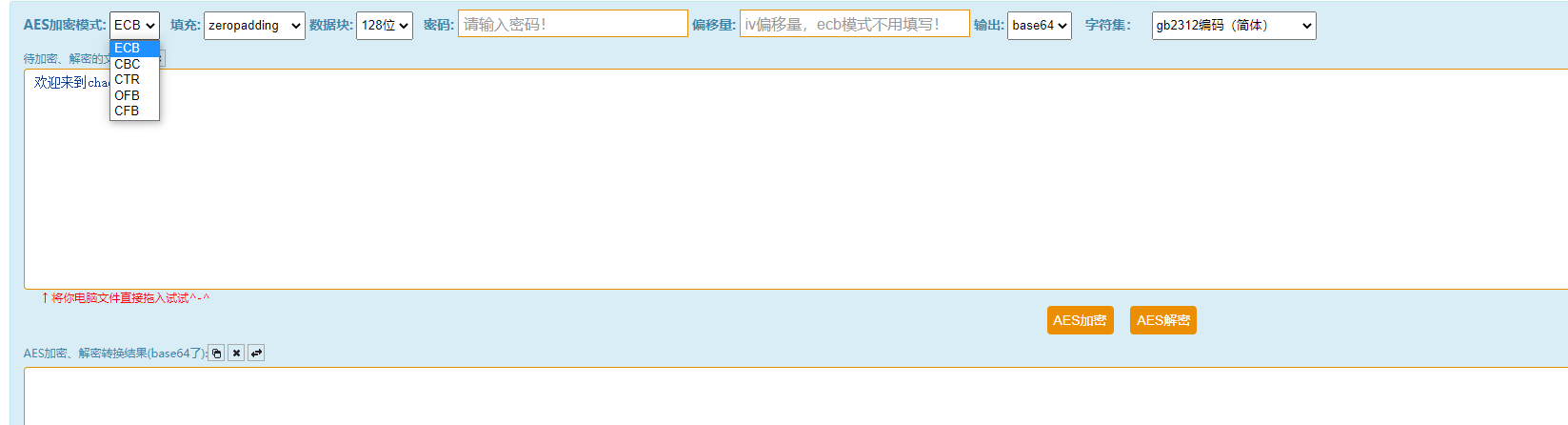
Electronic Codebook Book (ECB)
Cipher Block Chaining (CBC)
Counter (CTR)
Cipher FeedBack (CFB)
Output FeedBack (OFB)
3.1. Electronic Codebook Book (ECB)
ECB is the simplest mode is encryption modes.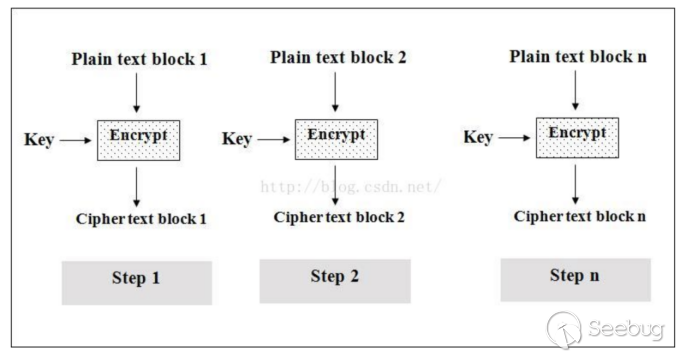
As we can see,we just need block the plaintext.Encryto every piece,than split joint every ciphertext.this is ECB encryption mode.
3.2. Cipher Block Chaining (CBC)
In this mode, the plaintext is first divided into several segments, and then each segment is XOR with the initial block(first segments) or the ciphertext segment of the previous segment, and then encrypted with the key.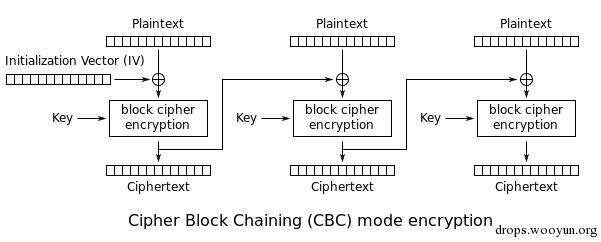
Explain this encryption flow chart:
• Ciphertext-0 = Encrypt(Plaintext XOR IV)—for first plaintext segment
• Ciphertext-N= Encrypt(Plaintext XOR Ciphertext-N-1)—othere plaintext segments
Decyption as same.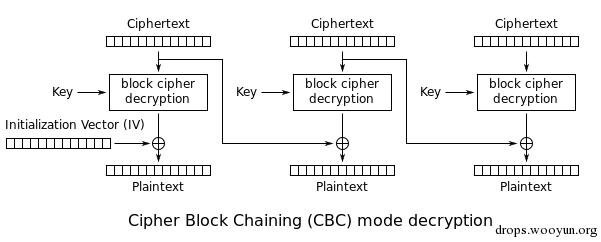
•Plaintext-0 = Decrypt(Ciphertext XOR IV) —for first ciphertext segment
•Plaintext-N= Decrypt(Ciphertext XOR Ciphertext-N-1)—othere ciphertext segments
4.CBC Byte Flipping Attack
Purpose of CBC Byte Flipping Attack:To change a byte in the plaintext by corrupting a byte in the ciphertext.
4.1.Working Principle
Note: The Ciphertext-N-1 is used to generate the plaintext of the next block; this is where the byte flipping attack comes into play. If we change one byte of the Ciphertext-N-1 then, by XORing with the net decrypted block, we will get a different plaintext! You got it? Do not worry, we will see a detailed example below. Meanwhile, below is a nice diagram explaining this attack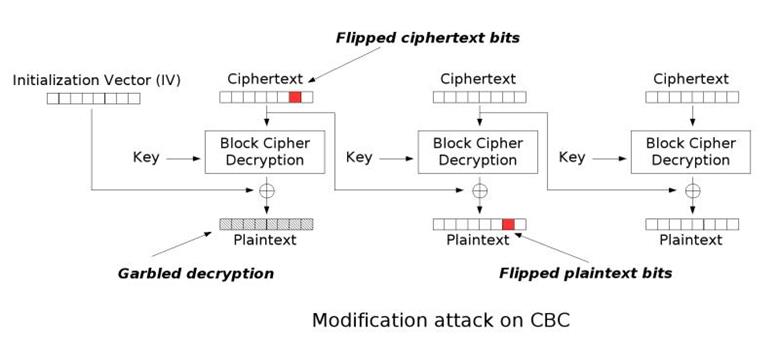
And this is we know in math
1 | Now_Plantext(A) = Now_Ciphertext(B) ^ Last_Ciphertext(C) |
so if we want let answer become “a”,we just need Last_Ciphertext ^ Now_Plantext ^ Now_Ciphertext ^ "A"
4.2.For example if we can change iv
1 | KEY = 'mHAxsLYz' |
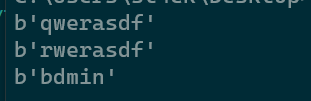
This env len(vi==Key),so we just need new_cipher=bytes([ord(chr(cipher[0]))^ord('a')^ord('b')])+cipher[1:]
1 | from pyDes import des, CBC, PAD_PKCS5 |
In php we use those func for cbc
1 | openssl_encrypt($plain, METHOD, SECRET_KEY, OPENSSL_RAW_DATA, $iv); |
4.2.1.Question of only change iv
source_code
1 |
|
exp1 for py2
1 | # -*- coding: UTF-8 -*- |
exp2 for py3
1 | # -*- coding: UTF-8 -*- |
4.3.change cipher&&iv
1 | #coding:utf-8 |
5.CBC Padding Oracle
5.1.Q
padding_serv.py
1 | ''' |
exp
1 | import socket |